PE-FILTER-ND-031 · Standard + Custom

Neutral Density Filters

Broadband optical attenuation with flat spectral response

Material
BK7 / Fused Silica substrate
Wavelength
All wavelengths (broadband)
Type
Attenuation (OD 0.1-6.0)
Category
Optical Filters
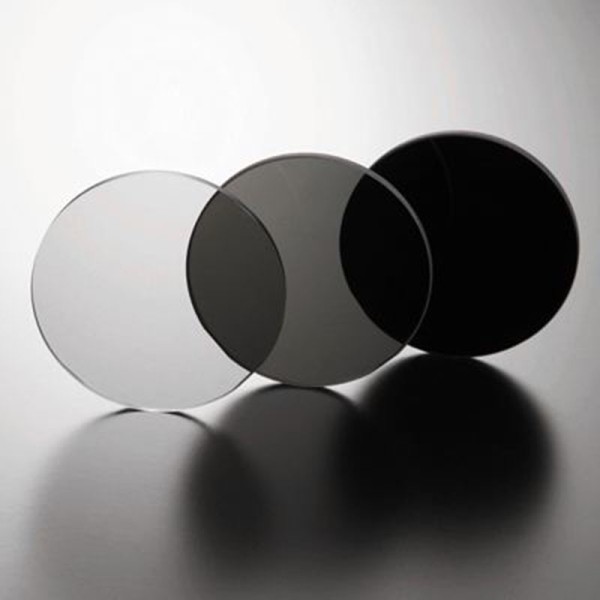
Neutral Density Filters

Key Specifications

TypeAbsorptive / Reflective ND
Optical DensityOD 0.1 - 6.0
Transmission100% to 0.0001%
Spectral RangeBroadband (design dependent)
SubstrateBK7 / Absorptive Glass
Diameter6-50 mm
Accuracy±5% OD typical
AOI0° (normal) recommended

What Is a Neutral Density Filters?

Neutral Density Filters are precision optical filters designed for laser power attenuation and reduction. They use thin-film interference to selectively transmit or block specific wavelength bands.

PhotonEdge designs custom filter coatings optimized for your specific wavelength requirements and application environment.

When Should You Use This Product?

✔ Good Choice When

  • ✓ Laser power attenuation and reduction
  • ✓ Detector protection from saturation
  • ✓ Calibration and reference standards
  • ✓ Optical system alignment and setup

⚠ Consider an Alternative When

✗ Wavelength-specific filtering → Narrow Band Filter
✗ Wavelength separation → Dichroic Filter
✗ Variable attenuation → Variable ND Filter
✗ Edge filtering → Longpass/Shortpass Filter

Available Optical Materials

Select the optimal substrate material based on your wavelength, environment, and budget requirements.

MaterialTransmissionKey AdvantageConsiderations
BK7VIS / NIR (350-2000nm)Low cost, good for visible applicationsNot suitable for UV < 350nm
UV Fused SilicaUV / VIS / NIR (185-2100nm)Required for UV center wavelengthsHigher cost than BK7
Borosilicate (B270)VIS (400-700nm)Economy choice for visible-onlyLimited wavelength range

Not sure which material to choose?

Ask AI Optical Engineer

Optical Coating Options

Absorptive Glass

Flat OD across broad spectrum. No wavelength dependence.

Typical use: Precision calibration, broadband attenuation

Metallic Thin Film

Reflective ND. Flat spectral response.

Typical use: Laser attenuation, beam sampling

Reflective ND (Metal)

Metal-coated reflective attenuators.

Typical use: High-power laser attenuation

How to Specify Your Coating

To select the right coating, please provide: (1) Operating wavelength, (2) Angle of incidence, (3) Required transmission or reflectivity, (4) Laser power density (if applicable), (5) Operating environment.

Engineering Considerations

Key factors to evaluate when specifying this optical component for your system.

Center Wavelength / Cut-off

Specify your target wavelength. For filters at non-normal incidence, account for AOI-induced wavelength shift.

Bandwidth / Edge Steepness

Narrower bandwidth or steeper edges increase cost. Specify the minimum performance required.

Blocking (OD)

Higher OD provides better out-of-band rejection but may reduce peak transmission.

AOI Effects

Increasing AOI shifts transmission curves toward shorter wavelengths. Specify your beam geometry for accurate performance.

Have a Custom Optical Requirement?

Upload your drawing or describe your specification. Our engineering team will review and respond within 24 hours with a detailed quotation.

Upload Drawing / RFQ Ask AI Optical Engineer

Applications

Spectroscopy

Beam conditioning, wavelength selection, and signal extraction in spectrometers.

Laser Systems

Laser line filtering, beam shaping, and optical filtering.

Fluorescence & Bioimaging

Excitation and emission filtering for fluorescence microscopy.

Research & Education

Optical measurement setups and spectroscopic analysis.

Manufacturing & Customization

PhotonEdge supports optical component sourcing, engineering review, and qualified manufacturing through our optical manufacturing network. We coordinate production, coating, and inspection to deliver components that meet your specifications.

🔬
Prototype
⚙️
Low Volume
🏭
Volume Production
📋
Custom Specification

Quality Assurance

Dimensional Inspection

Diameter, thickness, focal length verified per specification

Surface Quality

Scratch-dig inspection under calibrated illumination

Coating Verification

Spectrophotometric measurement of transmission/reflectance

Inspection documentation available according to project requirements. Certificates of Conformance, material test reports, and coating curves can be provided.

You May Also Need

Related Knowledge

Engineering Documentation

The following documentation is available upon request for qualified engineering projects:

📐
Dimensional Drawing

CAD & dimensional specs per your requirements

📊
Material Data Sheet

Material properties, transmission curves & certificates

📈
Coating Performance Curve

Spectrophotometric measurement data

🔍
Inspection Report

Surface quality, flatness, centration & dimensional data

✅
Certificate of Conformance

CoC with full traceability per project requirements

📋
Custom Specification Sheet

Application-specific specification documentation

Documentation availability depends on project scope and order quantity. Request details during RFQ.

Further Reading: Engineering Guides

Deepen your understanding with our engineering guides and application notes:

Optical Coatings Complete Guide Laser Optics Components Guide AR Coating Specification Guide Browse All Knowledge Center Articles Browse All Application Notes

Ordering Information

Price Range
See Quote
Standard Lead Time
Ships within 1 week after payment
Custom Lead Time
Subject to engineering evaluation
MOQ
1 Piece
Samples
Available

Contact us for exact pricing based on your specifications.

Specification Parameters

Typical Specifications shown on this page are standard capabilities. Available Options include alternative materials and coatings. Custom Specifications are available per your drawing. Requirements beyond standard capability are marked Subject to Engineering Review.

Get a Quote Full Ordering Guide

Frequently Asked Questions

Can I specify custom wavelengths?

Yes. We design custom filters for any center wavelength from 200nm to 2500nm. Provide your target specifications for a custom design.

How does angle of incidence affect filter performance?

For bandpass filters, increasing AOI shifts the center wavelength toward shorter wavelengths (blue shift). Always specify your beam geometry.

What does OD 4 blocking mean?

OD 4 means the filter blocks 99.99% of out-of-band light (transmission < 0.01%). Higher OD provides better blocking but may reduce peak transmission.

What substrate should I choose?

BK7 for visible, UV Fused Silica for UV wavelengths, Borosilicate for economy visible-only applications.

Can these filters handle high-power laser?

Hard dielectric coatings handle moderate to high powers. Specify laser power density for proper coating selection.

What is the typical lead time?

Standard filters ship within 1-2 weeks, depending on quantity and specifications. Custom designs require 3-4 weeks, subject to change based on order specifics.

What OD value do I need?

OD 0.3 = 50% transmission, OD 1 = 10%, OD 2 = 1%, OD 3 = 0.1%, OD 4 = 0.01%. Choose based on required attenuation.

Are absorptive or reflective ND better?

Absorptive: flat spectral response, no ghost reflections. Reflective: handles higher power, no thermal issues.

Not Sure Which Specification You Need?

Describe your optical system and our AI Optical Engineer will help identify the right specifications, materials, and coatings for your application.

Analyze My Requirement

Request a Quote

Provide your requirements and our engineering team will respond within 24 hours with a detailed quotation.

TypeOptical DensityTransmissionSpectral RangeSubstrateDiameterAccuracyAOI
Submit Engineering Request

Have a Custom Requirement?

Upload your drawing or specifications. Our engineering team will review and respond within 24 business hours.

Upload Your Drawing Request a Quote