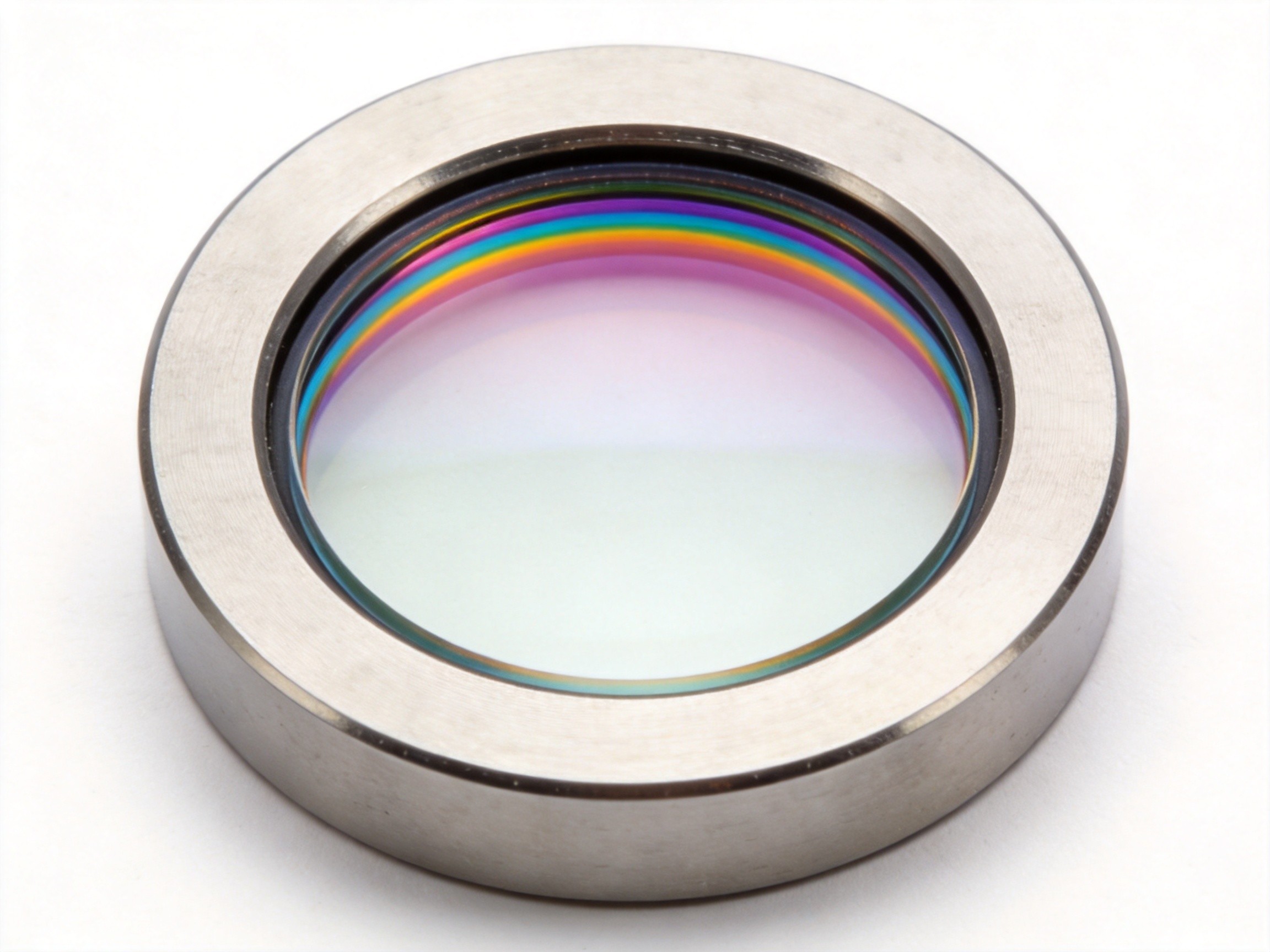
Precision wavelength selection for spectroscopy, fluorescence and machine vision
| Filter Type | Narrow Band Interference (Bandpass) |
|---|---|
| Center Wavelength | Custom (200 - 2500 nm) |
| Bandwidth (FWHM) | 1 nm - 40 nm |
| Peak Transmission | > 40% (standard) / > 90% (high-performance) |
| Blocking (OD) | OD 1-6 depending on design |
| Substrate Options | BK7 / UV Fused Silica / Borosilicate |
| Diameter Range | 6 mm - 200 mm |
| Incidence Angle | 0° (normal) / Custom AOI designs |
Narrow band interference filters selectively transmit a specific wavelength band while blocking all other wavelengths. They work on the principle of thin-film interference, using precisely controlled multi-layer dielectric coatings to create constructive interference at the target wavelength and destructive interference elsewhere.
These filters can replace expensive spectrometers in applications where only a specific wavelength band needs to be isolated. They are widely used in fluorescence microscopy, Raman spectroscopy, laser line selection, environmental monitoring, and machine vision inspection systems.
Select the optimal substrate material based on your wavelength, environment, and budget requirements.
| Material | Transmission | Key Advantage | Considerations |
|---|---|---|---|
| BK7 Substrate | VIS / NIR (350-2000nm) | Low cost, good for most visible applications | Not suitable for UV < 350nm |
| UV Fused Silica | UV / VIS / NIR (185-2100nm) | Required for UV center wavelengths | Higher cost than BK7 |
| Borosilicate (B270) | VIS (400-700nm) | Economy choice for visible-only applications | Limited wavelength range |
Not sure which material to choose?
Ask AI Optical EngineerIon-beam sputtered or e-beam evaporated dielectric layers. High environmental stability, high LIDT.
Typical use: Laser systems, outdoor instruments, demanding environments
Conventional evaporated dielectric layers. Lower cost, adequate for lab environments.
Typical use: Laboratory instruments, indoor applications
Mixed metal-dielectric designs for very wide blocking ranges.
Typical use: Applications requiring OD 4+ blocking
Combined absorptive and interference designs for ultra-wide blocking.
Typical use: Fluorescence microscopy, Raman spectroscopy
To select the right coating, please provide: (1) Operating wavelength, (2) Angle of incidence, (3) Required transmission or reflectivity, (4) Laser power density (if applicable), (5) Operating environment.
Key factors to evaluate when specifying this optical component for your system.
The peak transmission wavelength shifts toward shorter wavelengths as the angle of incidence increases. For non-normal incidence, specify the AOI so we can design the coating accordingly.
Narrower bandwidth provides better spectral isolation but reduces total transmitted energy and increases cost. Typical choices: 1-3nm for Raman, 10-20nm for fluorescence, 20-40nm for machine vision.
Optical density defines how well out-of-band light is suppressed. OD 3 means 0.1% transmission outside the passband. For fluorescence applications, OD 4-6 is often required to suppress excitation light.
Higher peak transmission means more signal. Narrow bandwidth designs trade peak transmission for selectivity. Typical values: 40-60% for narrow (< 5nm), 70-90% for moderate (10-40nm).
For converging or diverging beams, the effective AOI varies across the beam, causing bandwidth broadening and center wavelength shift. Specify the beam cone angle for accurate performance prediction.
Dielectric coatings shift approximately 0.01-0.02 nm/°C. For precision applications in varying temperatures, specify the operating temperature range.
Upload your drawing or describe your specification. Our engineering team will review and respond within 24 hours with a detailed quotation.
Emission and excitation filters for specific fluorophore bands. Combined with dichroic mirrors for complete filter sets.
Notch and bandpass filters for Rayleigh line rejection and Stokes/anti-Stokes signal extraction.
Wavelength-specific filters for inspection systems using LED or laser illumination.
Gas analysis, water quality monitoring, and atmospheric sensing using specific absorption lines.
PhotonEdge supports optical component sourcing, engineering review, and qualified manufacturing through our optical manufacturing network. We coordinate production, coating, and inspection to deliver components that meet your specifications.
Diameter, thickness, focal length verified per specification
Scratch-dig inspection under calibrated illumination
Spectrophotometric measurement of transmission/reflectance
Inspection documentation available according to project requirements. Certificates of Conformance, material test reports, and coating curves can be provided.
The following documentation is available upon request for qualified engineering projects:
CAD & dimensional specs per your requirements
Material properties, transmission curves & certificates
Spectrophotometric measurement data
Surface quality, flatness, centration & dimensional data
CoC with full traceability per project requirements
Application-specific specification documentation
Documentation availability depends on project scope and order quantity. Request details during RFQ.
Deepen your understanding with our engineering guides and application notes:
Contact us for exact pricing based on your specifications.
Specification Parameters
Typical Specifications shown on this page are standard capabilities. Available Options include alternative materials and coatings. Custom Specifications are available per your drawing. Requirements beyond standard capability are marked Subject to Engineering Review.
Narrow band filters have bandwidth (FWHM) typically below 40nm and isolate a specific wavelength. Broadband filters pass a wider range of wavelengths. Narrow band filters are more selective but transmit less total energy.
Yes. PhotonEdge designs custom narrow band filters for any center wavelength from 200nm to 2500nm. Provide your target wavelength, bandwidth, and blocking requirements for a custom design.
As the angle of incidence increases, the center wavelength shifts toward shorter wavelengths (blue shift). For converging beams, this causes bandwidth broadening. Always specify your beam geometry for accurate performance.
OD (Optical Density) 4 means the filter blocks 99.99% of light outside the passband (transmission < 0.01%). Higher OD values provide better blocking but may reduce peak transmission and increase cost.
For visible wavelengths (400-700nm), BK7 is the most economical choice. For UV center wavelengths (< 400nm), UV Fused Silica is required. For economy visible-only applications, B270 borosilicate glass is available.
Standard dielectric filters can handle moderate laser powers. For high-power applications, specify the laser power density and we will design with high-LIDT hard dielectric coatings.
Standard catalog filters ship within 1-2 weeks, depending on quantity and specifications. Custom narrow band filter designs typically require 3-4 weeks for development and production, subject to change based on order specifics.
Provide: (1) excitation wavelength, (2) emission peak wavelength, (3) required bandwidth, (4) blocking OD at excitation wavelength, and (5) whether it is for excitation or emission path. We will recommend the optimal design.
Describe your optical system and our AI Optical Engineer will help identify the right specifications, materials, and coatings for your application.
Analyze My RequirementProvide your requirements and our engineering team will respond within 24 hours with a detailed quotation.
Upload your drawing or specifications. Our engineering team will review and respond within 24 business hours.