PE-BS-CUBE-040 · Standard + Custom

Cube Beamsplitters

Cemented cube beamsplitters for compact, aligned beam splitting

Material
BK7 / Fused Silica
Wavelength
VIS / NIR (design wavelength)
Type
Cube Beamsplitter
Category
Optical Beamsplitters
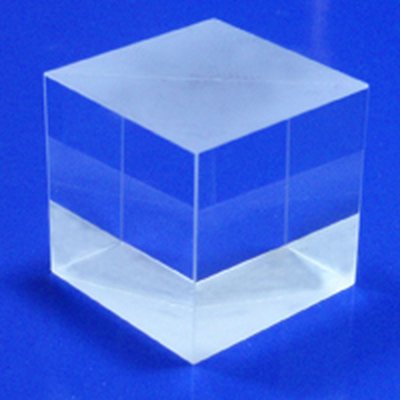
Cube Beamsplitters

Key Specifications

TypeCube Beamsplitter (Cemented)
Splitting Ratios50/50, 70/30, 90/10, Custom
SubstrateBK7 / UV Fused Silica
Size5-50 mm cube
Surface Quality40-20 / 20-10
FlatnessΞ»/4 @ 632.8nm
CoatingDielectric / Metallic at diagonal
AR CoatingsBroadband AR available

What Is a Cube Beamsplitters?

Cube beamsplitters consist of two right-angle prisms cemented together with a beamsplitter coating on the hypotenuse. The coating splits the incident beam into transmitted and reflected paths at 90 degrees.

The cube geometry provides mechanical stability, inherent alignment, and a compact form factor. They are the most widely used beamsplitter type in optical systems.

When Should You Use This Product?

βœ” Good Choice When

  • βœ“ Compact beam splitting with self-aligned geometry
  • βœ“ Laser beam sampling and monitoring
  • βœ“ Dual-detector systems
  • βœ“ Interferometer reference arms

⚠ Consider an Alternative When

βœ— Flexible splitting ratio β†’ Plate Beamsplitter
βœ— Polarization separation β†’ Polarizing Beamsplitter
βœ— Polarization-independent NP β†’ Non-Polarizing Beamsplitter
βœ— High extinction β†’ Glan Polarizer

Available Optical Materials

Select the optimal substrate material based on your wavelength, environment, and budget requirements.

MaterialTransmissionKey AdvantageConsiderations
BK7VIS / NIR (350-2000nm)Low cost, standard substrateNot for UV < 350nm
UV Fused SilicaUV / VIS / NIR (185-2100nm)UV-compatible, low absorptionHigher cost

Not sure which material to choose?

Ask AI Optical Engineer

Optical Coating Options

Dielectric 50/50

Wavelength-specific 50/50 splitting. High durability.

Typical use: Laser and precision systems

Metallic 50/50

Broadband 50/50 splitting. Flat spectral response.

Typical use: White light and broadband

Custom Ratio

70/30, 90/10, or other custom ratios.

Typical use: Application-specific splitting

How to Specify Your Coating

To select the right coating, please provide: (1) Operating wavelength, (2) Angle of incidence, (3) Required transmission or reflectivity, (4) Laser power density (if applicable), (5) Operating environment.

Engineering Considerations

Key factors to evaluate when specifying this optical component for your system.

Splitting Ratio

Standard 50/50 +/-5%. Custom ratios available. Specify wavelength for dielectric.

Polarization

Standard cubes are polarization-dependent. Specify NPBS for polarization-independent.

Beam Offset

Cube beamsplitters have no beam offset, simplifying alignment.

Cement Limitations

Standard cement limits operating temp to ~80C. For higher temps, consider air-spaced.

Applications

Laser Systems

Beam delivery, focusing, and conditioning for industrial and scientific laser systems.

Semiconductor

Wafer inspection, lithography support, and process control optics.

Machine Vision

Image formation in inspection systems and quality control cameras.

Research & Education

Laboratory optics, teaching setups, and experimental beam paths.

Manufacturing & Customization

PhotonEdge supports optical component sourcing, engineering review, and qualified manufacturing through our optical manufacturing network. We coordinate production, coating, and inspection to deliver components that meet your specifications.

πŸ”¬
Prototype
βš™οΈ
Low Volume
🏭
Volume Production
πŸ“‹
Custom Specification

Quality Assurance

Dimensional Inspection

Diameter, thickness, focal length verified per specification

Surface Quality

Scratch-dig inspection under calibrated illumination

Coating Verification

Spectrophotometric measurement of transmission/reflectance

Inspection documentation available according to project requirements. Certificates of Conformance, material test reports, and coating curves can be provided.

You May Also Need

Related Knowledge

Engineering Documentation

The following documentation is available upon request for qualified engineering projects:

πŸ“
Dimensional Drawing

CAD & dimensional specs per your requirements

πŸ“Š
Material Data Sheet

Material properties, transmission curves & certificates

πŸ“ˆ
Coating Performance Curve

Spectrophotometric measurement data

πŸ”
Inspection Report

Surface quality, flatness, centration & dimensional data

βœ…
Certificate of Conformance

CoC with full traceability per project requirements

πŸ“‹
Custom Specification Sheet

Application-specific specification documentation

Documentation availability depends on project scope and order quantity. Request details during RFQ.

Frequently Asked Questions

What splitting ratios are available?

Standard ratios include 50/50, 70/30, 90/10, and custom ratios. Both transmitting and reflecting percentages can be specified.

What is the difference between cube and plate beamsplitters?

Cube beamsplitters use cemented prisms with coating at the diagonal. Plate beamsplitters use a single substrate with coating on one surface. Cubes are more compact; plates offer more design flexibility.

Can I specify polarization-dependent or non-polarizing?

Yes. Both polarizing (PBS) and non-polarizing (NPBS) beamsplitters are available.

What wavelength range do you support?

From deep UV (200nm) through visible to mid-IR (5Β΅m+), depending on substrate and coating materials.

How do I specify a beamsplitter?

Provide: type (cube/plate), splitting ratio, wavelength, polarization requirement, size, and coating.

What is the lead time?

Standard beamsplitters ship within 1-2 weeks. Custom designs require 3-4 weeks.

Not Sure Which Specification You Need?

Describe your optical system and our AI Optical Engineer will help identify the right specifications, materials, and coatings for your application.

Analyze My Requirement

Request an Engineering Quote

Provide your requirements and our engineering team will respond within 24 hours with a detailed quotation.

TypeSplitting RatiosSubstrateSizeSurface QualityFlatnessCoatingAR Coatings
Submit Engineering Request