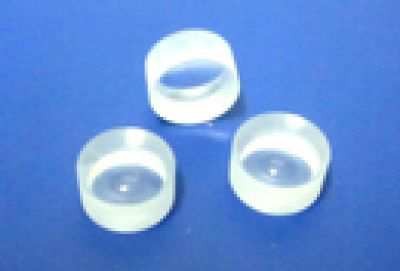
Symmetric diverging lenses for beam expansion and optical systems
| Material | N-BK7 (K9) |
|---|---|
| Diameter | 5-75 mm |
| Focal Length | -5 to -500 mm |
| Wavelength | 350-2000 nm |
| Surface Quality | 40-20 / 20-10 |
| Flatness | λ/4 @ 632.8nm |
| Symmetry | Equal R on both surfaces |
| Coatings | AR coatings available |
Bi-concave (double concave) lenses have two concave surfaces with equal radii. This symmetric negative lens provides uniform beam divergence regardless of orientation, simplifying alignment in optical systems.
They are used in beam expansion, as diverging elements in compound optical systems, and in applications where orientation-independent performance is beneficial.
Select the optimal substrate material based on your wavelength, environment, and budget requirements.
| Material | Transmission | Key Advantage | Considerations |
|---|---|---|---|
| N-BK7 | VIS / NIR (350-2000nm) | General-purpose, low cost, good homogeneity | Not suitable for UV < 350nm |
| UV Fused Silica | UV / VIS / NIR (185-2100nm) | Excellent UV transmission, low absorption, high LIDT | Higher cost than BK7 |
| CaF₂ | Deep UV / VIS / IR (130-7800nm) | Broadest transmission range, low refractive index | Fragile, higher cost |
| Sapphire | UV / VIS / NIR (150-5500nm) | Extremely hard (9H), scratch resistant | Birefringent, higher refractive index |
Not sure which material to choose?
Ask AI Optical EngineerBroadband AR for visible range. R < 0.5% per surface.
Typical use: General visible laser and imaging
AR for NIR range (780nm, 808nm, 850nm diodes).
Typical use: NIR laser diode collimation and fiber coupling
AR for 1064nm and nearby wavelengths.
Typical use: Nd:YAG and fiber laser systems
Low reflection across 400-1000nm broadband.
Typical use: Multispectral applications
Raw glass surface. ~4% reflection per surface.
Typical use: Non-critical applications
To select the right coating, please provide: (1) Operating wavelength, (2) Angle of incidence, (3) Required transmission or reflectivity, (4) Laser power density (if applicable), (5) Operating environment.
Key factors to evaluate when specifying this optical component for your system.
Symmetric design means performance is the same in either orientation, simplifying assembly.
Thinner at center than edges. Check minimum center thickness for structural integrity.
Pair with positive lenses for beam expanders, Galilean telescopes, and relay systems.
Beam delivery, focusing, and conditioning for industrial and scientific laser systems.
Wafer inspection, lithography support, and process control optics.
Image formation in inspection systems and quality control cameras.
Laboratory optics, teaching setups, and experimental beam paths.
PhotonEdge supports optical component sourcing, engineering review, and qualified manufacturing through our optical manufacturing network. We coordinate production, coating, and inspection to deliver components that meet your specifications.
Diameter, thickness, focal length verified per specification
Scratch-dig inspection under calibrated illumination
Spectrophotometric measurement of transmission/reflectance
Inspection documentation available according to project requirements. Certificates of Conformance, material test reports, and coating curves can be provided.
The following documentation is available upon request for qualified engineering projects:
CAD & dimensional specs per your requirements
Material properties, transmission curves & certificates
Spectrophotometric measurement data
Surface quality, flatness, centration & dimensional data
CoC with full traceability per project requirements
Application-specific specification documentation
Documentation availability depends on project scope and order quantity. Request details during RFQ.
We offer multiple substrate materials including N-BK7, UV Fused Silica, CaF₂, and Sapphire depending on your wavelength and environmental requirements.
Yes. PhotonEdge offers custom diameters, focal lengths, coatings, and surface qualities. Custom specifications typically require 4-6 weeks lead time.
40-20 is suitable for most laser and imaging applications. 20-10 is recommended for precision systems where scattering must be minimized.
The coating depends on your operating wavelength. For visible applications, AR 350-650nm is standard. For NIR lasers, choose the coating matching your wavelength. Uncoated is suitable for non-critical applications.
Yes. Dimensional reports, surface quality verification, and coating performance data are available according to project requirements.
Click the 'Request Engineering Quote' button and provide your diameter, focal length, wavelength, coating, surface quality, and quantity.
Bi-concave for orientation-independent divergence; plano-concave when orientation is fixed and minimum aberration matters.
Describe your optical system and our AI Optical Engineer will help identify the right specifications, materials, and coatings for your application.
Analyze My RequirementProvide your requirements and our engineering team will respond within 24 hours with a detailed quotation.